Address:
20 Park Plaza, Suite 804
Boston, MA 02116
978-888-7999
Address:
20 Park Plaza, Suite 804
Boston, MA 02116
978-888-7999


I’m Walking on Sunshine (And Don’t It Feel Good!)
— Katrina and the Waves
When the sun rises, it flips your brain’s natural “wake-up” switch. The first light of dawn is rich in invisible infrared and ultraviolet wavelengths that signal your eyes, skin, and brain that morning has arrived. Most people only catch this light if they’re early risers—farmers, fishers, or dog-walkers who beat the sun out the door. Certainly not me as a college student. I get up earlier now for a very good reason.
The curve of the earth divides sunlight at dawn into different wavelengths like a prism. Shorter blue wavelengths scatter, leaving the reds, oranges, and pinks to paint the sky —what Homer famously called the “rosy-fingered dawn.” Specialized cells in your eyes absorbs these color shifts and uses them to reset your internal clock. The rosy hues disappear within 15 minutes and the blue sky returns. This is enough to reset our circadian rhythm for another day.
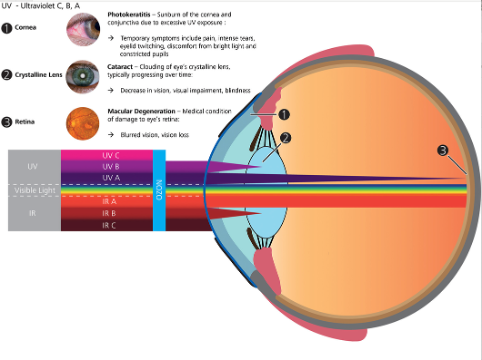
Different wavelengths of light penetrate the eye to different depths. Red light travels deepest, while blue light stops at the lens. Most of the light we see during our waking hours is in the red-yellow-blue spectrum—which is why the unique combination of red and near-infrared (no yellow and no blue) at sunrise is such a powerful biological signal.
Reddit Creative Commons
Humans evolved under sunlight over millions of years. Electric light is recent—about 200 years old—and disrupts sleep and waking patterns. It extends the workday into night shifts but does not activate the body’s circadian system at dawn. Incandescent bulbs may lift mood in winter, but without the sun, the physiologic boost is missing.
Sunrise alarm clocks have light source that starts at a low glow of orange and shifts to bright white over half an hour. They resemble dawn but lack the near-UV and near-infrared light that signals our brain’s clock. They may wake you more gently, but they do not reset your internal rhythm.
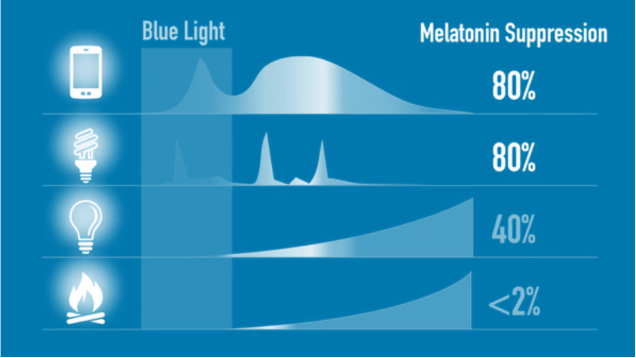
Blue light from computer screens, phones, TVs, and lamps suppresses melatonin, delaying sleep and lowering sleep quality. It disrupts your circadian rhythm. The modest amounts of blue light from lamps or wood fires has little effect on sleep or will cause fatigue the next day.
Too much melatonin upsets your sleep cycle. The ideal dose is small—0.3 to 0.5 mg, taken two hours before bed. In Europe, melatonin is prescribed in low doses. In the U.S., it is sold as a supplement, often in doses far higher than needed.
Supplements in the US don’t have to prove they work — only that they don’t cause harm — which is why mega-doses that don’t work can dominate the market. You think you getting a deal when you are really overdosing. Correct -dose options exist: you can find 0.3 mg (300 mcg) melatonin from a few brands online.
When proper melatonin dose supports the natural day-night cycle, everything runs better:
But when your rhythm is out of tune — from late-night screens, jet lag, night shifts, or yes, too much melatonin — you can have:
And if you’ve ever nodded off while driving? That’s your brain staging a hostile takeover called a microsleep. The risk of an auto crash jumps to four times normal, and no amount of coffee can fix it. The only safe plan: pull over, stop, walk around, or take a quick nap.