Address:
20 Park Plaza, Suite 804
Boston, MA 02116
978-888-7999
Address:
20 Park Plaza, Suite 804
Boston, MA 02116
978-888-7999

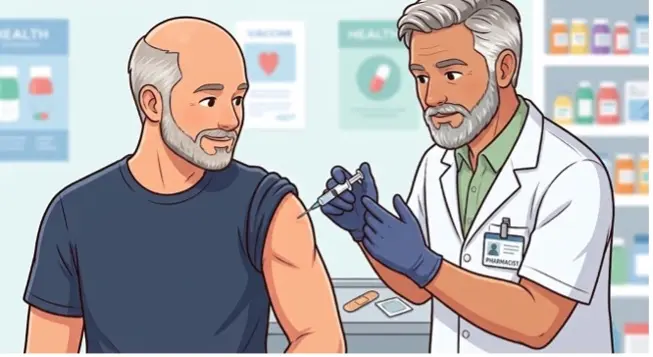
Every fall I roll up my sleeve at the CVS in East Milton Square. The pharmacist swabs my arm, I look away, and the shot is over in five seconds.
Some years I get the flu anyway.
That’s not because anyone messed up. Scientists need six months’ lead time to determine which antigens pose the most danger when winter hits. Some years the guess is wrong.
This year, for the first time, I might get a second shot in early 2027. A new mRNA flu vaccine from Moderna could close that gap between “some years” and “every year.”
Labs inject millions of incubating eggs with live virus to make flu vaccine. Technicians inactivate the grown virus, then harvest and purify its antigens, the molecular fragments your immune system learns to recognize.
Some egg protein sneaks through. That’s why anyone with a severe egg allergy gets a warning label.
As the virus grows inside all those eggs, it mutates to adapt to its new environment.
There’s a subtler problem too. As the virus grows inside all those eggs, it mutates to adapt to its new environment. That mutated antigen may not match the flu strain circulating outside your door. The whole process takes six months, giving the virus time to shift and drift while the vaccine brews.
mRNA vaccines skip the eggs. Manufacturers inject a snippet of engineered genetic code straight into a handful of your muscle cells, and those cells build the antigens, which attach to the surface of the muscle cells. No eggs, no allergy risk, no mutation drift. The result is a purer antigen. Years of manufacturing refinement have made the process gentler on the body than those early shots were. The 2021 COVID vaccine carried 100 micrograms of mRNA; the 2026 version carries 30. Side effects scale with dose, so many no longer occur.
Years of manufacturing refinement have made the process gentler on the body than those early shots were.
On August 5, the FDA approved Moderna’s mFlusiva, the first mRNA flu vaccine, for adults 50 and older. The trial numbers proved it: flu infections dropped 27 percent across 43,000 people in eleven countries.
Michael Osterholm, the infectious disease expert at the University of Minnesota, has spent decades watching flu vaccine technology barely budge. He calls this a milestone: “I think this is really a critical step forward in advancing influenza vaccine technology.”
“I think this is really a critical step forward in advancing influenza vaccine technology.”
The trade-off is real. In trials, people who got mFlusiva reported more soreness at the injection site and more fatigue in the first few days than people who got the standard egg-based shot. Nobody dropped out of the trial over it, and that stronger immune reaction lined up with fewer hospitalizations. The catch is timing. The delayed approval left Moderna scrambling to ramp up manufacturing, and the vaccine won’t reach pharmacies until January 2027.

Images Composed on Nano Banana 2
The holdup isn’t about manufacturing. Robert F. Kennedy Jr. has been outspoken against mRNA vaccines. Last year he cancelled 500 million dollars in mRNA research grants. He has done everything possible to delay the vaccine, even though it was already accepted by the EU, the British NHS, and multiple other countries.
In February, the FDA’s biologics center refused to review Moderna’s application. Its stated objection: the company had picked the wrong comparator vaccine, a requirement that didn’t exist. The agency’s own scientists pushed back, and the FDA reversed course, but then slow-walked the review right up to the last possible day.
Dr. Jeanne Marrazzo, CEO of the Infectious Diseases Society of America, put it plainly: “The FDA is signaling openness to this platform, which has been a controversy and an issue.” The science cleared the bar months ago. The politics didn’t.
Insurance coverage remains debatable. That decision belongs to the CDC’s Advisory Committee on Immunization Practices, which can’t meet because of legal disputes over who sits on it. So a better vaccine may not reach pharmacy shelves this winter while the system that decides who pays for it stays stalled.
My guess: the government foots the bill in the end. But that doesn’t help anyone who gets sick in November.
The familiar egg-based vaccine will sit on pharmacy shelves as usual this season. Moderna’s mass production will take 2-3 months to start shipping in volume.
It requires normal refrigeration, not the -80 degrees of original COVID vaccines. Regulators are still writing the policy on who should get the mRNA version, and when. I expect policy and regulations to delay utilization till the New Year.
I’ve had the flu. I don’t want it again. So I’ll get my usual shot this fall, the same as every year, in the same CVS, from the same pharmacist who’s stuck me a dozen times by now. If mFlusiva becomes available later in the season, I’ll consider rolling up my sleeve a second time.
Talk to your doctor about what makes sense for you. One essay, mine included, can only cover so much ground.